
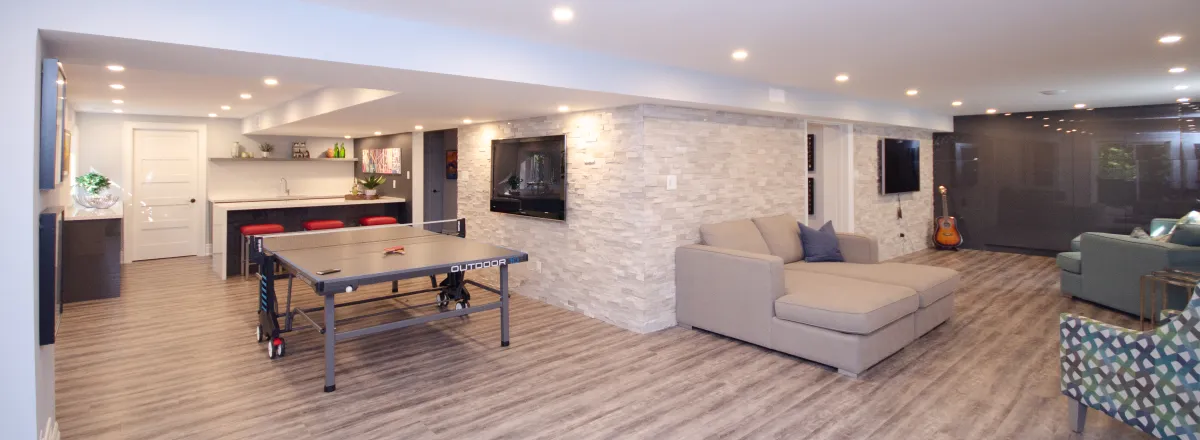
If you're looking at an unfinished or dated basement and wondering what it would actually take to turn it into real living space — you're asking the right question first. The honest answer is that a basement renovation in Durham Region runs from about $25,000 for a basic finish to $120,000 or more for a full legal suite. Most homeowners land in the $45,000–$70,000 range, and that budget delivers a warm, comfortable basement the whole family actually uses.
Here's a realistic look at where that money goes — and how to make sure yours lands where it matters most.
What Does a Basement Renovation Actually Cost?
The biggest factor in your basement budget isn't the flooring you pick or the pot lights you fall in love with — it's how much you're adding below grade. A wide-open rec room is straightforward. Add a bathroom, a kitchenette, or a legal bedroom, and the plumbing, electrical, and code work climb. That single decision shapes your number more than anything else.
Here's what Durham Region homeowners are investing across different project scopes in 2026:
| Project Level | Budget Range | What You Get |
|---|---|---|
| Basic Finish | $25,000–$45,000 | Framing, insulation, drywall, flooring, lighting, and a clean open rec room — no added plumbing |
| Mid-Range Finish | $45,000–$70,000 | Finished rec room plus a 3-piece bathroom, better lighting, upgraded flooring, and built-in storage |
| Full Renovation | $70,000–$100,000 | Bathroom, wet bar or kitchenette, dedicated rooms, egress windows, premium finishes throughout |
| Legal Suite / In-Law Suite | $100,000–$120,000+ | Full second kitchen, code-compliant egress and fire separation, separate entrance — a rentable, income-generating unit |
Prices reflect 2026 Durham Region market rates. Your basement's size, ceiling height, and existing conditions will affect your final number.
The sweet spot for most families is the mid-range finish. You get a genuinely finished basement with a bathroom — which is what makes the space truly usable — at a number that makes sense relative to your home's value.
What Does a Basement Renovation Cost Per Square Foot?
Per square foot is often the easiest way to sanity-check a basement budget. In Durham Region, finishing a basement typically runs $40 to $100 per square foot in 2026, depending on scope. A simple open finish sits at the low end; once you add a bathroom, a kitchenette, or a legal suite, you move toward the top. For a 1,000-square-foot basement, that's roughly $40,000 for a basic finish and $80,000–$100,000 for a fully built-out space. Square-foot pricing is a useful starting point. Still, the layout and the systems you install ultimately matter far more than the raw footprint.
Where Your Budget Goes
Understanding the breakdown helps you make smarter trade-offs — and feel better about where your money is actually going.
Framing, Insulation, and Drywall: 25–30% of your total budget This is the shell of the project — the part that turns a concrete box into rooms. Proper insulation and a moisture-managed wall assembly are especially critical in a basement. Below grade is where comfort and air quality are ultimately determined.
Flooring: 10–15% Basements call for flooring that handles the occasional bit of moisture. Quality luxury vinyl plank is the workhorse choice down here — warm, durable, and forgiving. Tile and engineered options cost more but suit bathrooms and higher-end finishes.
Electrical and Lighting: 10–15% Basements start dark, so lighting does heavy lifting. Recessed pot lights, dedicated circuits, and enough outlets are what make the finished space feel like the rest of the house rather than a converted cellar.
Plumbing: 10–20% This swings your whole budget. A finished basement with no plumbing skips it entirely. Add a bathroom and you're into rough-ins, and if the drains sit below the sewer line, you'll need an up-flush system or a sewage ejector pump — budget accordingly.
Ceiling: 5–10% A finished drywall ceiling looks best but buries your access to the systems above. A drop ceiling costs less and keeps shut-offs and wiring reachable. Many Durham basements use drywall in the living areas and a drop ceiling in the utility zone.
Contingency: 10–15% Older Durham Region homes sometimes reveal surprises behind basement walls — moisture, outdated wiring, low headroom, a cracked floor. Building a contingency from the start means you won't be caught off guard, and what's left over can go toward an upgrade you were on the fence about.
What Makes a Basement Renovation Cost More
A few decisions move the budget significantly — and it's worth knowing them upfront so nothing catches you off guard.
Adding a bathroom is the single most common cost multiplier. A basement bathroom adds roughly $15,000–$25,000 depending on whether your drains allow a standard rough-in or require an up-flush system. It's almost always worthwhile. A basement without a bathroom remains a rec room; a basement with one becomes a genuine second living level. See our full bathroom renovation cost guide for how those numbers break down.
Egress windows are required for any legal basement bedroom. Cutting and installing a code-compliant egress window in a foundation wall runs $3,500–$7,000 including the window well and excavation. It's not optional if you want the room to count as a bedroom.
Lowering the floor or underpinning to gain ceiling height is the most expensive thing you can do in a basement — it can add $30,000–$80,000 on its own. It's only worth considering when low headroom would otherwise make the space unusable.
A kitchenette or second kitchen pushes you toward the legal-suite tier: added plumbing, a dedicated electrical load, ventilation, and code separation all stack up.
What Keeps Costs Down (Without Sacrificing Quality)
The good news: there's a lot of room to be smart about where your money goes.
Keep it open. An open-concept basement with one large flexible space costs far less than carving out multiple closed rooms with doors, returns, and extra electrical. For most families, open is also how the space actually gets used.
Skip the plumbing — for now. If a bathroom isn't in this year's budget, a good designer can rough in the drain location so you can add one later without tearing the floor back up. You get a finished basement now and an easy upgrade path later.
Choose finishes that fit the room. Luxury vinyl plank over tile, a drop ceiling in the utility zone, and standard-trim doors free up budget for the things that actually change how the space feels — lighting and a clean, warm layout.
At Floor and Bath Design, we have seen every version of this: "The best basements are the ones where the homeowner is honest about how they'll really use the space. Once we know whether it's a playroom, a home office, a guest suite, or a rental, we can build a plan without spending on rooms the customer won’t use, and we can budget accordingly."
What You Get Back: Resale, Living Space, and Rental Income
A finished basement pays you back in more ways than one in Durham Region:
| Renovation Type | Typical Cost | ROI | What You Get Back |
|---|---|---|---|
| Basic finished basement | $25,000–$45,000 | 70–75% | Added square footage buyers can see and use |
| Mid-range with bathroom | $45,000–$70,000 | 70–75% | A genuine second living level — a strong selling point |
| Legal second suite | $100,000–$120,000+ | Income | Monthly rent that can cover a meaningful chunk of the mortgage |
For a straight finish, expect to recover 70–75% of your cost at resale — and to enjoy the added space every day in the meantime. The legal-suite math is different, and increasingly popular in Durham Region. A code-compliant basement apartment generates rental income that can offset the mortgage — which often matters more than the resale percentage.
How to Think About Your Basement Budget
Before you commit to a number, a few questions worth sitting with:
How will you actually use the space? A kids' playroom, a home office, a media room, a guest suite, and a rental apartment all carry very different budgets. Match the investment to the real use, not the Pinterest version.
Do you need a bathroom down there? If the basement is more than an occasional-use room, the answer is almost always yes — and it's far cheaper to do it during the renovation than to add it later.
Are you staying or thinking of renting? If a rental suite is on the horizon, it's worth building to code from the start. Retrofitting a finished basement into a legal suite later costs more than doing it once.
What's your moisture situation? A dry basement is the foundation of everything. If you've had water, address it before you finish — it's always cheaper than coming back through new walls.
The most useful hour you'll spend before your basement renovation is a conversation with someone who's finished hundreds of them. That's what the free consultation at Floor and Bath Design is for, just an honest look at your space, your goals, and a realistic budget that makes sense for your home.
Ready to Finish Your Basement?
Whether you're picturing a bright family room or a full income suite, the starting point is the same: knowing what you want, what it costs, and what to expect along the way.
Floor and Bath Design has been helping Durham Region homeowners for over 30 years. Bring your photos, your ideas, and your questions — we'll help you figure out the rest.
Floor and Bath Design · 109 Old Kingston Road, Unit 4, Ajax ON · 905-683-0079
Frequently Asked Questions
How much does a basement renovation cost in Durham Region in 2026?
Most basement renovations in Durham Region run $45,000–$70,000 in 2026, with a basic open finish starting around $25,000–$45,000 and a full build-out reaching $70,000–$100,000. A legal second suite with its own kitchen and code-compliant egress can exceed $120,000. The right number depends on your basement's size, ceiling height, and whether you're adding a bathroom or kitchen.
How much does it cost to finish a basement per square foot?
In Durham Region, finishing a basement typically costs $40 to $100 per square foot in 2026. A simple open finish sits at the low end; adding a bathroom, kitchenette, or legal suite moves you toward the top. For a 1,000-square-foot basement, that's roughly $40,000 for a basic finish and $80,000 or more for a fully built-out space.
How much does it cost to add a bathroom to a basement?
A basement bathroom adds roughly $15,000–$25,000, depending on whether your existing drains allow a standard rough-in or require an up-flush system or sewage ejector pump. If the drains sit below the sewer line, budget toward the higher end. It's one of the highest-value additions you can make — it's what turns a basement into true living space.
What's the difference between a finished basement and a basement renovation?
"Finishing" a basement means completing an unfinished space for the first time — framing, insulation, drywall, flooring, and lighting. A "renovation" usually means reworking a basement that was finished before. The cost is similar, but a renovation can run a little higher if old materials need removing or moisture issues need addressing first.
Can I turn my basement into a legal apartment in Durham Region?
In most cases, yes — second suites are permitted across much of Durham Region, but they must meet building and fire code: a code-compliant egress window or exit, proper ceiling height, fire separation, and often a separate entrance. A legal suite runs $100,000–$120,000+, but the rental income can offset a meaningful share of your mortgage. Always confirm requirements with your municipality before you start.
How long does a basement renovation take?
A basic finish typically takes 3–5 weeks. A mid-range basement with a bathroom runs 5–8 weeks. A full legal suite with a second kitchen and egress work can take 8–12 weeks, depending on permits and inspections. Permit timelines vary by municipality, so build that into your planning.
Does finishing a basement increase your home's value in Durham Region?
Yes. A finished basement typically returns 70–75% of its cost at resale and makes your home more attractive by adding usable square footage. A legal second suite changes the math further — the rental income it generates can matter more to buyers than the resale percentage alone.
